

Why Are Exchange Rates Different Across Forex APIs? Understanding Data Sources, Quote Timing, and Spreads
Why do different Forex APIs return different exchange rates? This article explains how data sources, quote timing, Bid/Ask spreads, timestamps, and data processing can affect forex prices and how developers can compare them consistently.
When developing a real-time forex market data page, developers may encounter a common situation: different Forex APIs return slightly different prices for the same currency pair, such as EUR/USD. One API may display 1.08520, while another returns 1.08524. Sometimes the difference appears only in the last few decimal places. In other cases, the gap between the bid and ask prices may also be noticeably different.
It is not necessarily accurate to attribute this issue directly to “API latency.”
Forex quotes can differ because of variations in data sources, quote types, sampling times, and spread calculation methods. For fintech developers, the real challenge is not finding an “absolutely correct” exchange rate. It is understanding why two prices differ and determining whether that difference affects the application's business logic.
First, Make Sure You Are Comparing the Same Type of Forex Quote
Before comparing two Forex APIs, the first thing to check is not the decimal places but whether the quotes use the same pricing basis.
Taking EUR/USD as an example, a forex quote may contain the following prices:
| Data | Example |
|---|---|
| Bid | 1.08518 |
| Ask | 1.08522 |
| Mid | 1.08520 |
Bid is the bid price, and Ask is the ask price. The difference between them is the Bid-Ask Spread:
Spread = Ask - Bid
       = 1.08522 - 1.08518
       = 0.00004
If one system uses the Bid price while another uses the Mid price, their displayed exchange rates will naturally differ.
Therefore, when investigating exchange rate discrepancies, developers should confirm at least four things:
Whether the currency pair is the same, whether the quote type is the same, whether the quote timestamps are close, and whether the spread is calculated on the same basis.
Particular attention should be paid to inverse currency pairs such as EUR/USD and USD/EUR. They represent prices in opposite directions and cannot be compared directly as if they were the same quote.
Why Do Forex Quotes Differ Across Data Sources?
Unlike markets centered around centralized exchanges, the spot forex market has an over-the-counter (OTC) structure. There is no single global quote that represents every market participant.
Different data providers may connect to different liquidity sources and use their own quote aggregation, filtering, and distribution processes to produce the final market data. As a result, even when two APIs provide quotes for the same EUR/USD pair, their prices may differ by a few points.
This is why the fact that “two APIs return different exchange rates” does not, by itself, prove that one of the data sources is incorrect.
A more reliable approach is to standardize the comparison criteria first.
For example, suppose two data sources return the Bid price for EUR/USD:
Data A
Bid = 1.08518
Time = 10:00:00.120

Data B
Bid = 1.08520
Time = 10:00:00.180
The two prices differ by 0.00002, but their sampling times also differ by 60 milliseconds.
When the market is moving quickly, this difference may be caused by the different times at which the quotes were generated, rather than by a data quality issue.
Therefore, when comparing forex quotes, developers should compare the Timestamp alongside the Price.
Different Quote Times Naturally Lead to Different Exchange Rates
Real-time forex quotes are not static numbers.
Suppose the price of a currency pair changes several times within a short period:
10:00:00.100    1.08520
10:00:00.160    1.08523
10:00:00.220    1.08518
If Program A retrieves the data after the first quote is generated, while Program B retrieves it after the third quote is generated, the two systems may display different prices even if neither has significant latency.
Developers need to distinguish among three timestamps:
Market event time: The time in the market to which the quote actually corresponds.
Server receive time: The time when the market data arrives at the data service's system.
Client receive time: The time when the developer's application receives the API data.
If the application records only the time when the client receives the data, it becomes difficult to determine whether the issue originates in the market, the data service, or the application's own network path.
For this reason, when building a forex monitoring system, it is advisable to store both the original timestamp and the local receive time.
Forex Spread Data Is Another Important Source of Exchange Rate Differences
When developers see different EUR/USD prices on two platforms, they may compare only a single “latest price.”
However, in forex quotes, Bid and Ask represent different trading directions.
For example:
Bid = 1.08518
Ask = 1.08522

Spread = 0.00004
If System A displays the Bid price while System B displays the Ask price, the difference of 0.00004 does not necessarily indicate a data inconsistency.
That is why storing only a single price field is not recommended when building a forex monitoring system.
A more practical data structure should retain at least the following fields:
symbol
bid
ask
spread
event_time
received_time
With these fields available, developers can investigate a “different exchange rate” issue through a clear sequence:
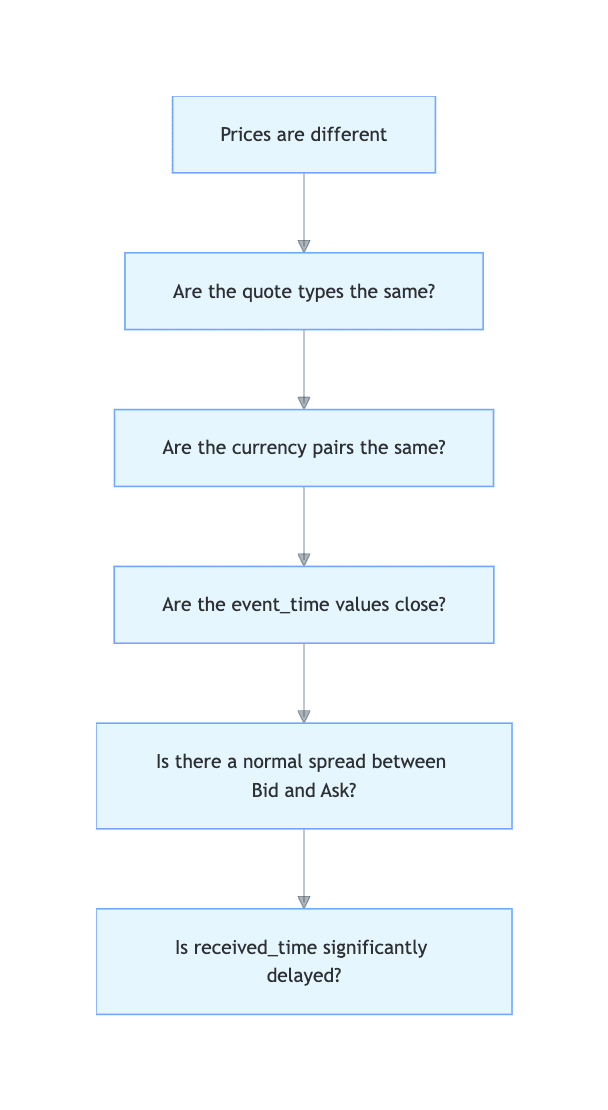
This makes it easier to identify the cause than simply refreshing the page and sending another API request.
Use a Consistent Basis to Check Forex API Quote Differences
When evaluating multiple forex data sources at the same time, developers can start with a simple comparison function.
The following code does not determine which data source is “better.” Instead, it converts quotes from different sources into a consistent structure and calculates the price differences and timestamp difference.
from decimal import Decimal


def compare_quotes(source_a, source_b):
    bid_a = Decimal(str(source_a["bid"]))
    bid_b = Decimal(str(source_b["bid"]))

    ask_a = Decimal(str(source_a["ask"]))
    ask_b = Decimal(str(source_b["ask"]))

    time_diff_ms = abs(
        int(source_a["event_time_ms"]) -
        int(source_b["event_time_ms"])
    )

    return {
        "bid_diff": str(abs(bid_a - bid_b)),
        "ask_diff": str(abs(ask_a - ask_b)),
        "time_diff_ms": time_diff_ms,
        "spread_a": str(ask_a - bid_a),
        "spread_b": str(ask_b - bid_b),
    }


quote_a = {
    "bid": "1.08518",
    "ask": "1.08522",
    "event_time_ms": "1793260800120"
}

quote_b = {
    "bid": "1.08520",
    "ask": "1.08524",
    "event_time_ms": "1793260800180"
}

print(compare_quotes(quote_a, quote_b))
The prices in this example are illustrative data. They do not represent actual market quotes at a specific time.
The practical value of this comparison method is that it does not treat every price difference as a latency issue.
For example:
Bid difference: 0.00002
Ask difference: 0.00002
Time difference: 60 ms
If the quote timestamps from the two data sources are different, developers should continue monitoring prices within the same time window instead of immediately assuming that one API is returning abnormal data.
On the other hand, if the timestamps are aligned but the Bid and Ask prices continue to show a noticeable difference over time, the data sources and quote aggregation methods should be investigated further.
How AllTick Forex API Supports These Development Requirements
When developing a real-time forex monitoring page, exchange rate display, or quantitative data processing system, it is important to check whether the data interface provides enough underlying quote information.
AllTick Forex API provides Tick-level Bid/Ask quotes for more than 50 currency pairs. It also provides OHLC K-lines and historical time series, with both REST and WebSocket access available.
This allows developers to select an access method according to how the data will be used:
- For initial page loading or on-demand queries, REST can be used to retrieve market data snapshots.
- For continuous price updates, WebSocket can be used to receive real-time data.
- When analyzing the relationship between buy and sell prices, developers can process Bid/Ask directly instead of treating trade prices as bid and ask quotes.
- For historical analysis, OHLC data and historical time series can be used.
AllTick's order book interface uses bids and asks to represent buy and sell quotes. According to the current official documentation, forex order book data supports up to one level and provides price and quantity fields. This means that when an application only needs to identify the current best bid and best ask, its data processing logic can be built around the first level of quotes.
For real-time systems, developers should also avoid confusing the “API response time” with the “market event time.” By storing the market event timestamp and recording the receive time on their own server, developers can determine whether data is accumulating or being delayed in the processing pipeline.
When using WebSocket to receive continuous market data, developers should follow the official protocol to handle subscription requests and push messages, rather than trying to simulate real-time streaming through high-frequency REST polling. AllTick's official developer resources position REST for request-based data access and WebSocket for continuous real-time data streams.
What Should You Check When Evaluating Forex API Reliability?
When two Forex APIs return different exchange rates, it is not advisable to judge them based only on the price at a single moment.
A more reliable approach is to establish consistent comparison criteria:
| Check | What to Verify |
|---|---|
| Currency pair | Is the pair exactly the same? Is one quote reversed? |
| Quote type | Are Bid, Ask, Mid, or Trade prices being compared consistently? |
| Timestamp | Are the event timestamps of the two quotes close? |
| Spread | Is the difference between Bid and Ask within a reasonable range? |
| Data continuity | Are there long periods without updates or unexpected price jumps? |
| Receive pipeline | Is there any backlog caused by client-side processing, caching, or network issues? |
| Historical behavior | Is the discrepancy occasional or persistent over time? |
With this approach, the question “Why are exchange rates different across Forex APIs?” becomes more than a simple price comparison. It becomes a data quality issue that developers can investigate step by step.
For fintech developers, this method is also suitable for systems that need to scale across multiple currency pairs and data sources. By standardizing the quote basis first and then comparing price, timestamp, and spread, developers can determine whether the system is being affected by market movements, differences between data sources, or their own data processing pipeline.
When selecting or integrating forex market data, developers can review AllTick's Forex API product information and official developer documentation. Pay particular attention to supported currency pairs, Bid/Ask data, REST and WebSocket access methods, and the actual API fields. Then test the interface against the requirements of the real-time forex application.